
How to Buy a Diamond
Buying a diamond can be an intimidating process. For many first time diamond buyers, this is one of the most important/stressful financial decisions he or she has ever made.
To anyone in this position, it is important to remember that you are making this purchase to symbolize what should be the happiest, most significant moment of your life to date. The following information is intended to educate and assist novice and seasoned diamond buyers in understanding the details important in purchasing a diamond and enjoying the process.

Why is a Diamond Significant?
Diamonds, named for the Greek word “unbreakable”, have been used in jewelry and religious icons for thousands of years; they are considered by most to be the most widely recognized and highly prized gem in the world. They are synonymous with elegance, luxury and ever-lasting love and bring sparkle and pleasure to all who encounter them. Our diamond birthstone page is loaded with interesting information if you would like to learn more about the history of diamonds.
At Levy’s, we understand that making a diamond selection is a very important decision. With all the standards of perfection, colors, cuts and carats, where is one to start?
The Four C’s of a Diamond’s Grade
The four C’s of diamonds are carat , cut , color and clarity .
Carat
Diamonds are measured by units of weight called, carat, which is equal to 200 milligrams or 0.2 grams. Carats are measured out to the hundredth place to offer precise measurements. Larger diamonds are much more rare than smaller ones and are therefore much more expensive proportionately to their weight than smaller stones of similar quality.
The word “carat” was first used in the 1400’s and comes from the Italian word, carato, which comes from the Greek word kerátion, meaning “carob seed”, the seed on which the measurement used to be based. A “carat” historically had different weights in different countries, and was not universally established as 0.2 grams until the Fourth General Conference on Weights and Measures, in 1907.
Cut
A diamond’s sparkle is created through the mirror-like reflection of light internally amongst the facets. While the cut of a diamond refers often refers to general shape (round, cushion, oval, etc); it can be further broken down to measure a stone’s proportions, symmetry, finish and polish. These factors determine the fire, brilliance, sparkle and overall beauty of the stone, and are graded as either poor, fair, good, very good, excellent. The cut of a diamond is the only factor influencing the stone’s value that is directly affected by humans and where the diamond cutter’s art and skill can truly present itself. A round brilliant triple excellent cut diamond, will reflect light from one mirror-like facet to another, until it releases through the top of the stone, while cuts that are too shallow or deep may impede the natural brilliance and reflectivity.

What Does “Triple Excellent” Mean?
The term “triple excellent” refers to the cut of a stone, which has received the grade of “Excellent” for “Cut Grade”, “Polish” and “Symmetry”. This grade is only available in round brilliant cut diamonds, because fancy cut stones do not receive a “cut grade”.
The “Ideal Cut” Modern Round Brilliant
The Ideal Cut of a diamond describes a round, brilliant stone that has been cut to exact, mathematically correct proportions so that light entering from any direction is 100% reflected through the top and dispersed into a display of sparkling flashes and rainbow of colors.
The first round brilliant cut diamond was designed in 1919 by Marcel Tolkowsky. A Russian diamond cutter who was fascinated by the reflective qualities of diamonds, Tolkowsky derived a mathematical formula to bring out the optimal amount of brilliance and fire within a stone. He published his work in his book, Diamond Design, in 1919 and technology advancement made finally made it possible to cut stones to these specifications decades later.
Color
Color describes the amount of body color the diamond contains (usually slight tinges of yellow or brown). This ranges from completely colorless to light yellow, with whiter stones usually being considered as more desirable than darker ones. The color is graded from “D” through “Z”, with “D”, “E” and “F” being considered “colorless”. These stones are going to be the most expensive because colorless diamonds are much rarer than stones with a hint of color.
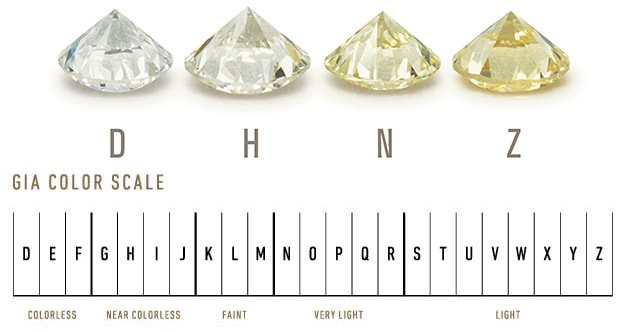
Once you start to move past “Z” in color, the color grade becomes what is considered “fancy”. Fancy colored diamonds can be yellow, brown, black, blue, red, green, or any other color imaginable. These stones are graded on an entirely different scale and can demand much higher prices, depending on rarity. Red diamonds are the rarest (and therefore most expensive), followed by pink, purple, violet, blue and green diamonds.
Diamond Color Treatments
Sometimes, a diamond is treated to appear whiter than it actually is. These treatments are rare, but can be spotted by a trained gemologist and are recognized and disclosed on most diamond grading reports.
- Coating: This method of enhancing diamond color involves covering the outside of a stone in a very thin layer of chemicals, plastic or even synthetic diamond.
- HPHT: High-Pressure, High-Temperature treatments can make a diamond appear more white, but it can also bring out other fancy colors, such as pink, blue, green or yellow.
Clarity
Clarity refers to the internal cleanliness of the diamond. Most diamonds include small particles called “inclusions”. These inclusions come from imperfections in the process of carbon (coal) transforming into the diamond over the course of the million plus years this natural process takes to complete. The number, size, nature and location of these inclusions helps to determine a diamond’s clarity grade. Diamonds categorized as flawless (F) or internally flawless (IF) show no inclusions and are the most rare, followed by “VVS1-2” (Very, Very Slightly Included), “VS1-2” (Very Slightly Included), “SI1-2” (Slightly Included) and “I1-3” (Included). By definition, inclusion grades are measured based on their nature, size, location and quantity inside of a stone

What are Inclusions, Really?
There are many different types of inclusions, which can occur internally or externally.
External Inclusions:
- Bearding: These are marks, usually found on or coming from the girdle, which are most often creating during the process of cutting or bruting. In small amounts, these fine line inclusions, also known as “girdle fencing” or “dig marks” can resemble a strand of hair and usually do not present a problem in small amounts.
- Blemish: These are characteristics which occur on the outside of a diamond. They can occur naturally, but most often form during the process of cutting or polishing the stone.
- Fingerprints: Inclusions that have a strong resemblance to fingerprints can be found in diamonds, although they are much more common in rubies and sapphires. These inclusions occur most often when fluid heals fractures in a stone under high temperatures and pressure. These inclusions are commonly found in diamonds which have undergone HTHP (High Temperature, High Pressure) treatments, but can also occur naturally.
- Fracture: A fracture is a usually irregular break in a diamond that is not parallel to the cleavage plane, which have a tendency to make a stone look chipped. Fracture filling is a common practice to hide these inclusions, but it is not permanent. Fracture filled diamonds can be detected by a Graduate Gemologist or diamond grading laboratory and their clarity grade should reflect the quality of the stone before it has been treated.
- Naturals: The term “natural” refers to the original surface of the diamond, which has not been polished. These external inclusions are most often found in the girdle and are relatively common, as cutters attempt to save as much weight as possible while cutting the stones. Indented natural inclusions can also occur; these can be polished out, but often at the expense of decreasing the weight of the stone by as much as 25%. Natural inclusions in the girdle are rarely noticeable, even under magnification.
- Nicks/Chips: Nicks are chips in the surface of the diamond, which are most commonly repaired by adding extra facets. This improves the clarity, but too many facets can potentially reduce the brilliance of a diamond.
- Pits: Small holes that breach the surface of a diamond. They are not easily noticeable to the naked eye, unless they occur in the table facet of the diamond.
- Scratches: Scratches are fine lines found on the surface of a diamond. They can occur naturally or as a byproduct of cutting the stone. Light surface scratches can often be polished out, but deep scratches can require more invasive treatment.
Internal Inclusions:
The conditions which allow diamonds to grow can also promote the growth of other crystals, or even other diamonds, inside of the stone. These “inclusions” come in many different shapes, colors and varieties and affect the value on the stone based on their individual size, shape, color and position inside the stone.
- Carbon: Diamonds are created when carbon, usually graphite, experiences extreme heat and pressure over the course of billions (not millions) of years. However, the stone does not always entirely crystalize during this process. This could leave small black specs inside the stone, in the form of graphite, pyrrhotite or pentlandite. In white diamonds, these dark inclusions can affect the clarity grade of a stone more heavily that a white inclusion of equal size and location. Carbon inclusions are most often found in white or bluish-white stones, very rarely appearing in fancy colored diamonds.
- Cloud: A cloud is a term used to describe three or more pinpoint inclusions, which are close enough together to give the stone a small hazy area under magnification. Small clouds are barely noticeable, even under magnification, but larger clouds inside a stone can become visible to the naked eye and disrupt the brilliance of a diamond.
- Feathers: A feather is a term that covers any crack on the inside of a stone. These inclusions (which look like feathers, hints the name) are not uncommon and do not pose a threat to the durability of the stone, unless they run across a majority of the stone, show stress points where the stone could break or reach all the way to the surface. These inclusions are usually two-dimensional, having a length and height, but no width.
- Etch Channels: During the billion or so years it takes to create a diamond, the rough stone is often brought into contact with high-temperature fluids, which etch into the stone’s crystal structure and leave irregular lines or tunnels inside the diamond.
- Grain Lines: Grain lines are small lines which can occur as a result of variables in crystallization or as a result of improper polishing (usually when a stone has slight variations in hardness). Grain lines are usually difficult to remove, without serious weight loss, and are most commonly found in pink diamonds.
- Intergrowths: Intergrowths are different types of inclusions (pinpoints, needles and/or feathers) grow together during a diamond’s formation. When they form together like this, it can create a white line, which can potentially be noticeable to the naked eye.
- Knot: A knot occurs in a diamond when an internal crystal reaches the edge of the stone. Diamond cutters usually try to eliminate these inclusions, but it is not always possible. Knots can create raised spots on a stone and could potentially affect the durability of a stone, as well as its clarity. These inclusions can potentially leave a cavity in the stone if they are pulled out during the polishing process.
- Needles: As diamond crystals grow inside of a diamond, they can sometimes for the shape of a needle inside the stone. These inclusions can usually be hidden by good cutting and are rarely noticeable to the naked eye, unless they are a different color from the rest of the stone.
- Pinpoint Inclusions: These tiny, usually white, inclusions are the most commonly found imperfections in diamonds. Pinpoint inclusions are hardly ever noticeable to the naked eye, and are usually so subtle under magnification, that they generally have little effect on the stone’s overall clarity grade. Many diamond grading reports do not even plot them on the inclusion diagram but instead leave a comment such as “pinpoints not shown”.
Diamond Clarity Enhancements
Sometimes a diamond is treated to remove or cover up inclusions inside a stone. These treatments are detectible by a trained gemologist and are usually disclosed on a diamond grading report. When grading a clarity enhanced diamond, the grader always refers to the clarity grade of the stone, before the treatment. GIA will disclose the treatment on laser drilled stones, but will not grade stones with temporary treatments, such as fracture filling.
- Laser Drilling: This process is used to remove small, dark inclusions. During this process a laser creates a miniscule hole in the stone and burns away the dark inclusions, creating a channel which is usually filled with a bleaching agent.
- Fracture Filling: This form of clarity enhancement hides feather inclusions by filling them with a glass-like substance, which better blends with the interior of the stone. This method of treatment is not permanent, and can be removed by thorough cleaning in an ultra-sonic machine. If your diamond is fracture filled, it is best to disclose this before leaving your stone with a jeweler or having it professionally cleaned.
Fluorescence
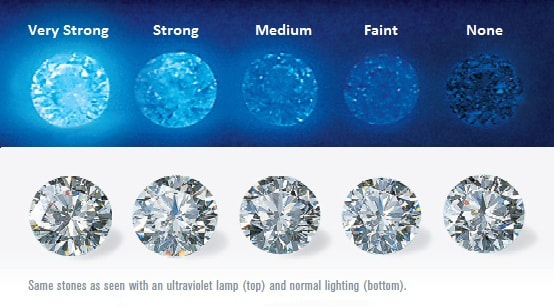
Fluorescence refers to the visible light emitted within a diamonde when it comes into contact with ultraviolet light. Some diamonds with strong fluorescence will light up a blinding blue, others show very slight change and some show none at all. It is estimated that approximately 25-35% of gem quality diamonds show some form of fluorescence with about 10% showing strength ranging from medium to strong blue according to GIA. Blue is by far the most common color shown from a fluorescent diamond (approximately 95%), but in rare cases, some diamonds can show yellow or white when subjected to UV light.
Fluorescence is not necessarily always a bad thing. While it usually makes no impact on the visual appeal of a diamond, a stone with a yellowish tint and fluorescence will often face up a little bit whiter than the color would initially suggest, and only in very rare cases will fluorescence have any effect on the clarity of a diamond.
Who Came Up With the System for Grading Diamonds?
Robert M. Shipley, a well-known jeweler in his day, created the Gemological Institute of America (GIA) with the goal of protecting the reputation of the jewelry industry by setting the standards for gemstone grading.
Experiencing and recognizing the general lack of expertise amongst American jewelers in regards to the gemstones they bought and sold, Shipley traveled to Europe, where he completed the Great Britain National Association of Goldsmiths gemological correspondence course. Upon his return to Los Angeles, Robert Shipley was inspired to create his own course in gemology on September 16, 1930, with the goal of training and certifying jewelers.

This course, and Mr Shipley’s actions, paved the way for legitimizing gemology as a recognized science; due to his contributions to the jewelry industry and the field of gemology, Robert Shipley was recently named JCK’s Person of the Century. Among GIA’s early contributions to gemology include patenting a jewelers loupe with a triple aplanatic lens in 1934, patenting the world’s first gemological microscope in 1937 and establishing a diamond grading system based on Shipley’s Four C’s, in 1953 which quickly became the international standard for measuring diamond quality.
Today, GIA continues to set the standard for gemological advancement by training and certifying aspiring gemologists and developing innovational methods to detect treatments and synthetics in diamonds and gemstones.
Diamond Grading Labs: What’s the Difference?
Not all diamond grading labs are created equal. Many grading labs offer companies generously graded reports to encourage them to send more stones to their lab. This makes the stone look really good on paper, but ultimately, it means a customer could end up purchasing a stone, which might not match the quality represented on the certificate.
Gemoligical Institute of America (GIA) – GIA is considered to be the touchstone of diamond grading in the jewelry industry. Their grading system has set the industry standard, and their standards on diamond grading are stricter than any lab in the world. A GIA report guarantees the quality of the diamond you are buying.
European Gemological Lab (EGL) – EGL is actually a name used by a group of laboratories which are not affiliated with each other in any way. The most popular of these labs being EGL-International , EGL-Israel and EGL-USA .
EGL-International and EGL-Israel are both notorious in the diamond industry for offering reports that are often considered to be so inaccurate that they are typically discarded. Some of these reports can differ by up to 4 color grades and 2 clarity grades when the same stone is graded by GIA. They have also been known to greatly exaggerate other important grading factors such as cut and fluorescence. Often difficult to notice to the untrained eye, these misrepresentations can cost unaware consumers thousands of dollars.
EGL-USA is considered to be the most credible of the independent EGL laboratories. These reports are usually on par with GIA (when grading the same exact stone), rarely differing by more than 1 grade in color or clarity.
American Gem Society (AGS) – AGS is a credible diamond lab that is usually on par with GIA’s diamond grading standards. AGS prides themselves on the fact that they were the first grading laboratory to introduce “cut” grades. In an AGS report, the color, clarity and cut are graded on a scale of 1-10, with the best grade being “Triple Zero”.
Other Independent Grading Labs – There are many other diamond and colored stone grading labs around the world, some of which are far more credible than others. It should be noted though, that not all unknown laboratories offer inaccurate reports.
The best way to make sure you are getting an accurately graded stone that is not graded by GIA is to view it under magnification next to a similar stone which is GIA certified.
Kimberly Process
The Kimberly Process is a joint initiative involving governments, industry and civil society established to halt the flow of conflict diamonds (rough diamonds mined by children or used by rebel movements to finance wars against legitimate governments). The Kimberly Process Certification Scheme (KPCS) was created in 2000 when Southern African diamond-producing states met in Kimberly, South Africa to discuss a way to stop the trade of conflict diamonds.
The KPCS imposes extensive requirements on its members to enable them to certify shipments of rough diamonds as Conflict-Free , preventing conflict diamonds from entering legitimate trade. Participants of the Kimberly Process may only trade with other members who have met minimum requirements of the scheme. Since the inception of the Kimberly Process, diamond experts estimate that a fraction of one percent of diamonds in international trade are conflict diamonds compared to 15% in the 1990’s.
Recycled Diamonds
The increasing popularity of recycled diamonds , stones reused from older pieces of jewelry, has also played a significant role in protecting the environment. It is estimated that 1 ton of Earth has to be extracted to product a 1ct diamond. When a stone has been recycled, it accounts for one less stone that needs to be mined.
Nearly every diamond that has ever been mined is still in circulation today, and among diamond dealers, most stones sold across the world are not fresh out of the mine. Even De Beers, the largest miner and supplier of diamonds in the world for over a century, has started a program to buy back diamonds from the public to recirculate previously-owned diamonds into the jewelry industry.
How Do I Take Care of My Diamond?
Diamonds are the hardest substance known to man, but they are not entirely indestructible. They can potentially be chipped when hit at the right angle or when repeatedly rubbed up against another diamond.
Aside from physical damage, diamonds can get dirty very quickly from everyday things like soap, hand lotion or hairspray and begin to lose their sparkle. Diamonds are very easily to clean and scrubbing with a toothbrush and warm water/soap solution is usually enough to bring back the shine. If that doesn’t work, we are always happy to clean your diamond jewelry, completely free of charge.